
Written by Wynter Worsthorne, Founder AnimalTalk Africa Trust.
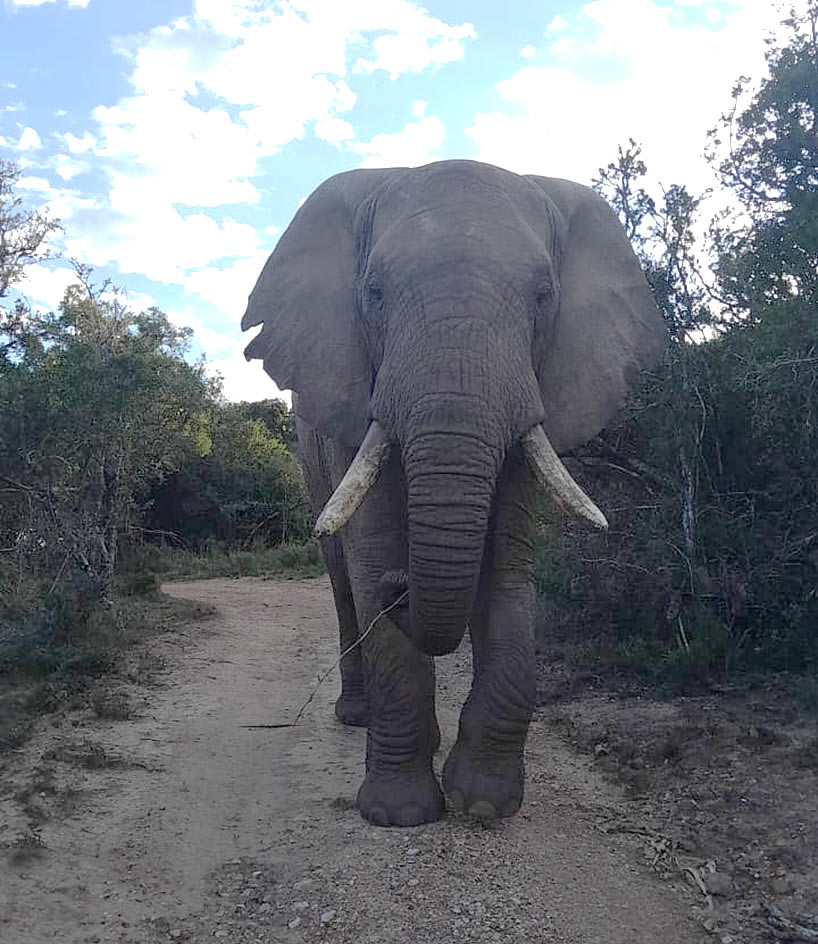
Tswale investigating his new home. Photo by A. Jivendava
“Modjadji…Modjadji.” The name resounded in my mind and in my heart: the name of the Rain Queen of the Venda community, from the northern areas of South Africa.
May 2019: Australian documentary maker, Rachel Dunn, was filming for “Through Elephant Eyes”, a movie about Elephants in captivity focusing on how they feel about it. I was living in Cape Town. We tried to find a captive Elephant operation nearby that would allow me to be filmed communicating with their Elephants. Even though the Western Cape has the most tourist Elephant interaction facilities in South Africa, none consented. Rachel was about to give up and return home without the footage she needed.
“Modjadji” kept coming to me, so we Google searched “Modjadji Elephant”: there was indeed an Elephant who had been given that name. She also had a brother, called Tswale. The siblings were being used for Elephant-back safaris on a private farm near the Kruger National Park. Amazingly we were invited to film ‘these clever Elephants’. A 6-year journey commenced, of perseverance filled with frustration, heartache and trauma.
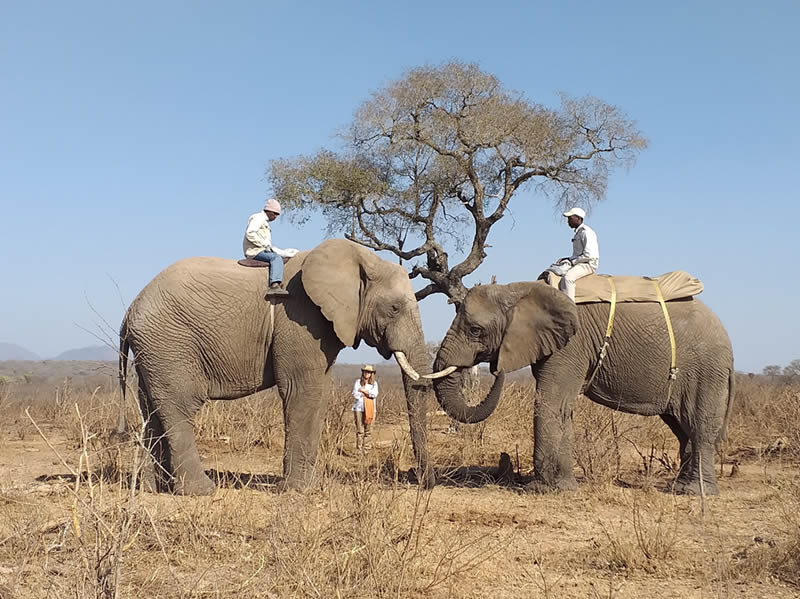
Tswale (left) and Modjadi getting ready for tourists to ride them. Photo by S. Jamieson
We bore witness to the way these two Elephants were being used. Modjadji showed me the trauma they’d both suffered since being wrenched from their wild family as juveniles – how they were forced to accept humans on their backs. We committed to helping them to attain freedom.
The Elephants had been captured and removed from their wild family in 2004, destined for a Tourist Adventure Industry training programme. Tswale was 9 years old and Modjadji 11 years old.
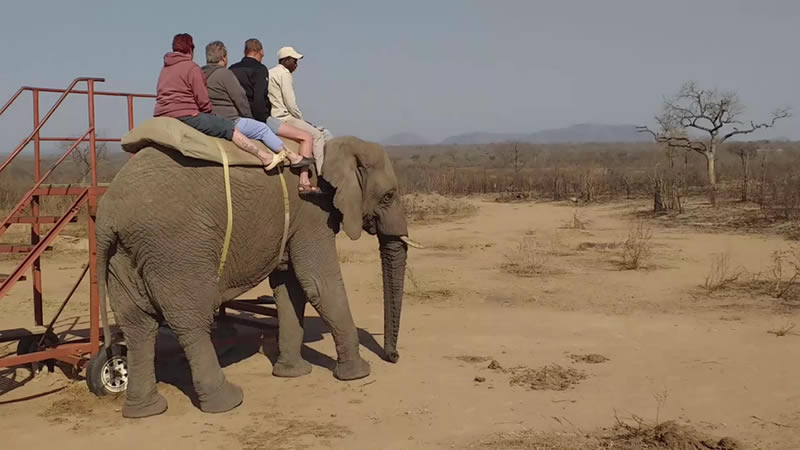
Modjadji with paying tourists on her back, with one of the handlers. Photo by S. jamieson
We collaborated with EMS foundation and WeWild Africa. We all followed their journey, petitioned the government for their release, worked with their ‘owner’, encouraging them to allow the Elephants to be free with the wild herd that they had come to know on the property where they were being kept. To no avail. We gained shocking insight into the greed, corruption and cruelty around the captive Elephant industry in South Africa.
Tragedy struck when the property changed hands: Modjadji and Tswale were bound in chains. Modjadji broke her leg in a desperate attempt to break free. She had to be euthanised. Tswale, in shock and traumatised, was moved with his handler, Amos Jivendava, to a neighbouring property where he was put straight back to work interacting with tourists to ‘earn his keep’.
We intensified our efforts to free Tswale: with seemingly no other option we attempted to purchase him from his ‘owner’, raised funds and started negotiations. A safe space was found where he could be rehabilitated into the wild with a small herd. His health was checked by our trusted veterinarian. All seemed to be on track. Then at the last minute the owners reneged.
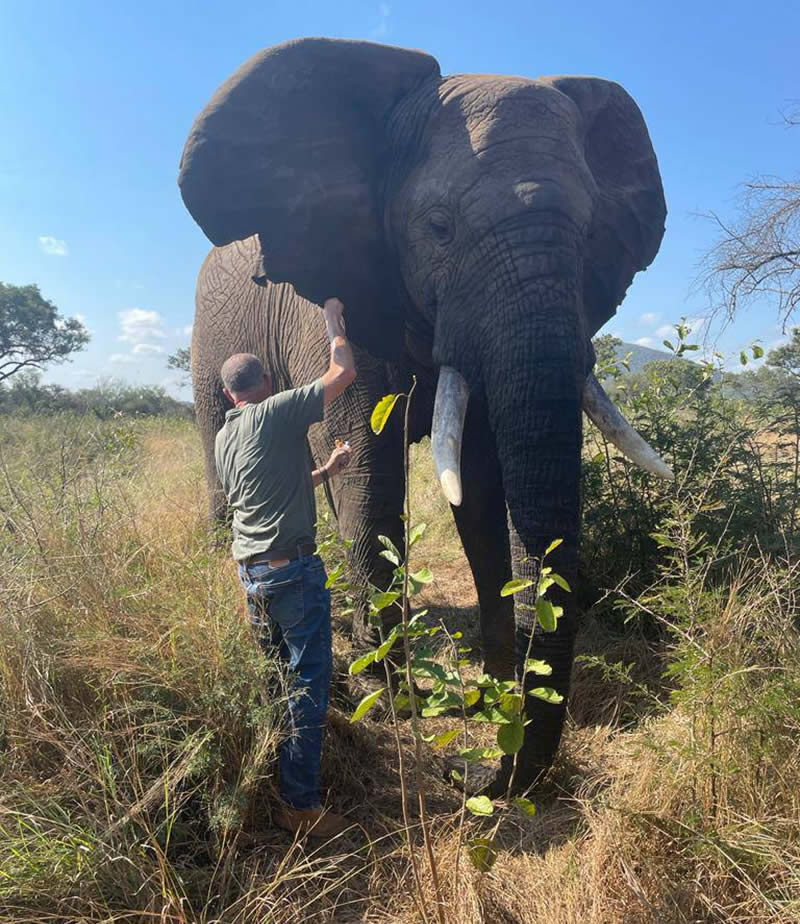
Dr Rogers doing the first vet check
As we were already uncomfortable about offering a substantial amount of money to the abusive owner, we chose to see the positive in the outcome. We returned to the original plan of petitioning the government to remove Tswale from his life of incarceration for human vanity and entertainment. It should have been simple: Tswale was being held without appropriate permits, his new ‘owner’ did not abide by the Elephant Norms and Standards law of South Africa, on land they no longer owned and were occupying illegally.
It took another two years to persuade the government to support us in removing Tswale. In February 2025, during a covert operation involving armed security, Tswale with Amos was finally moved to a secure, undisclosed reserve with no other human contact. There he was able to move freely, choose from a myriad of natural browse, and re-learn his wild ways.
Throughout this time, I communicated intuitively with Tswale, checking in on his well-being and preparing him for his final move. The relationship between him and Amos was strong, yet complicated: both had been trapped in a situation of enslavement that they could not escape without assistance from humans who cared about their plight.
Six months later the day came to move Tswale to his forever home: a 23-hour journey by road. I travelled to Nelspruit to accompany him, Amos and the relocation team. Everyone was duly concerned as any Elephant relocation is a risky operation. Throughout my ongoing communications with Tswale and the herd he would be joining, it felt right. Although there were very real fears around the success of the operation because of the excessive distance and new environment, I trusted the process.
I checked in with Tswale the night before his move, going through each step of the process with him. I heard his voice clearly in my heart. “Am I going home?”
I was confused because I wasn’t sure what ‘home’ meant, I asked. “What does home mean to you?”
One resounding word floated into my consciousness. “FAMILY!”
“Yes, Tswale, you’re going home!” I responded.
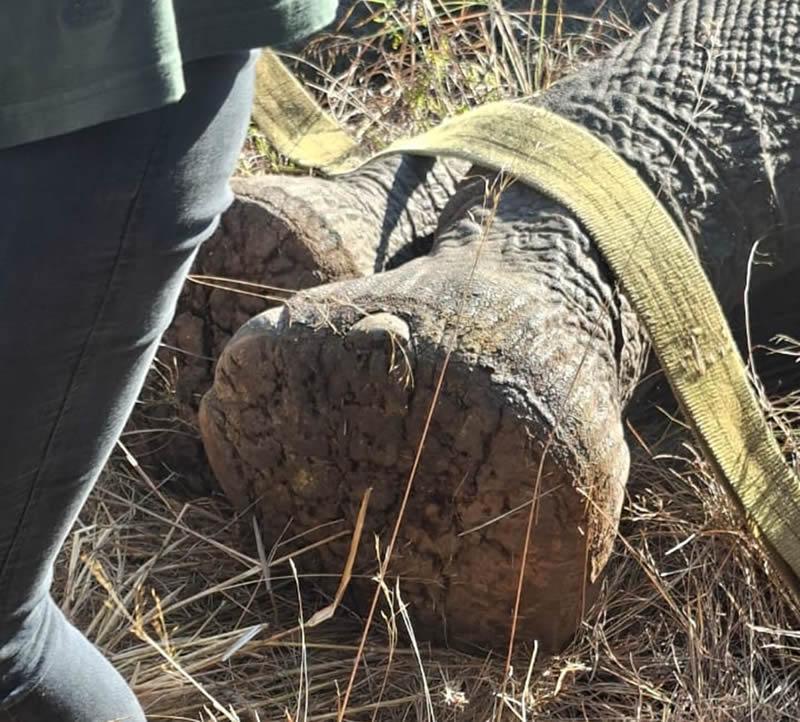
Tswale’s feet as he lies fully tranquilised, just before being transferred into the travel crate.
The “loading” of Tswale into the truck, although hard to watch, went smoothly. The long journey continued slowly, non-stop through the night traversing the length of the country. Tswale remained strong, stoic all the way.
We arrived at his new home at Bellevue Forest Reserve in the Eastern Cape at midday. Once inside his holding boma, we needed to get Tswale out of the truck, which was already heating up under the blazing sun, only the ramp was too short. In true boer-maak-‘n-plan fashion a heap of soil appeared to bridge the gap. Tswale teetered at the threshold of freedom, his trunk lifted in the air investigating this new place.
He descended, each deliberate step tentative, until he stood firmly on the earth, where a long cool drink of water awaited him. He drank long and deep, then flapped his ears, swished his tail, and followed Amos into the cool, dense bush bursting with delicious new vegetation. He curled his trunk around a leafy branch, ripped, and crunched, content.
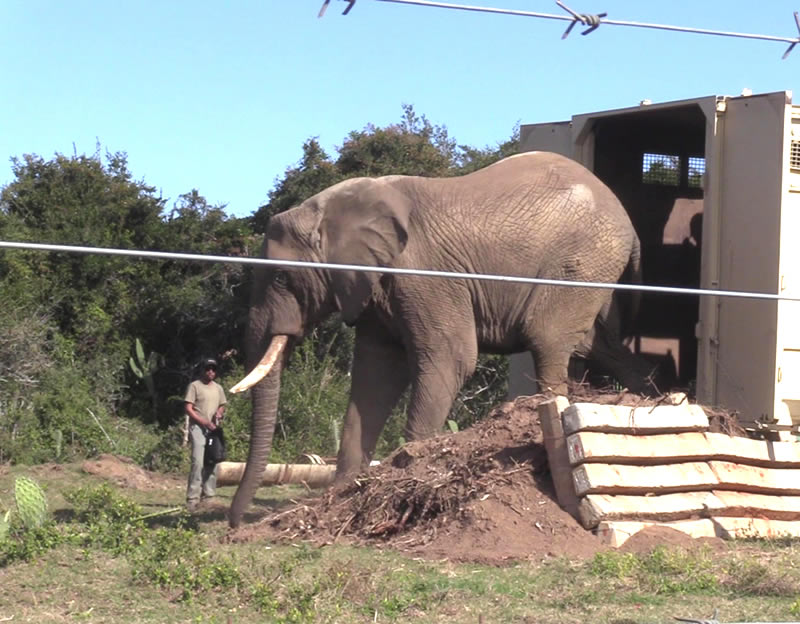
First tentative steps with Amos reassuring him. Photo S. Jamieson
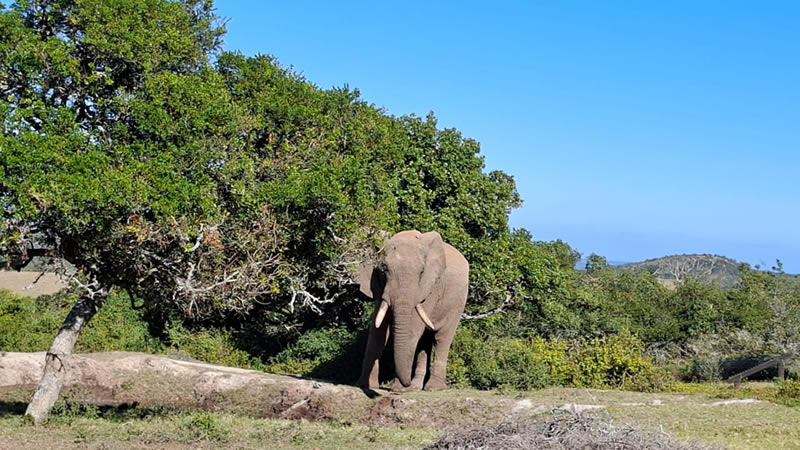
Tswale approaching the watering hole in his acclimation area. Photo S. Jamieson
When we arrived, the resident herd, about a kilometre away, started communicating with Tswale immediately. His deep tummy rumbles in return reported by Amos were the first in many years. It took five days for the herd to appear and meet him. They introduced themselves through the gaps in the electrified fence, and remained near the barrier until the following morning.
When the herd began to wander back into the bush, Tswale became agitated and showed that he wanted to be with them. Then too impatient for the humans to make a decision and open the gate, he simply flattened the fence, which for that moment in time was inexplicably unelectrified. He turned towards Amos for a final goodbye, and followed the tracks of the wild herd.
Unhindered, the herd welcomed Tswale who integrated immediately, stepping into his role as guardian and protector of the herd. He had his freedom and made his choice.
Tswale with his new family. Recorded by L. Buchner, owner of Bellevue Forest Reserve
Tswale has since continued to bond with his new family, showing no signs of wanting to leave or to seek any human company.
Tswale is HOME.
With thanks to:
Amos Jivendava, who has also gained his freedom and has chosen to move on to assist in the rewilding of other Elephants in captivity.
Rachel Dunn, who continues to document the stories of captive Elephants around the world.
EMS Foundation, who supported this mission with their knowledge, expertise and influence from the outset.
Dereck Milburn of WeWild Africa and Wildlife Emergency Fund, who negotiated with the authorities, assisted with funding and oversaw the whole operation.
Dr Peter Rogers of ProVet, expert Wildlife Veterinarian, who guided the veterinary process from the start.
Kester Vickory of Conservation Solutions for his relocation expertise and services.
Mpumulanga Parks and Tourism Association.
Bellevue Forest Reserve, for offering Tswale a new home and family.
My fellow AnimalTalk Africa Trust Trustees.
HEART Pride members for HEART support, as well as their financial contributions*.
*All funds raised for the initial purchase of Tswale were used for his relocation and rehabilitation.
The first time I intuitively communicated with Tswale, when we were finding a suitable place for his new home, I “tuned in” to the Elephants who would need to welcome him, specifically the resident bull Elephant. The song “He ain’t heavy, He’s my brother” by the Hollies came to me. A poignant and appropriate message on many aspects of Tswale’s journey.
The road is long
With many a winding turn
That leads us to who knows where, who knows where
But I’m strong
Strong enough to carry him
He ain’t heavy, he’s my brother
So on we go
His welfare is of my concern
No burden is he to bear
We’ll get there
For I know
He would not encumber me
He ain’t heavy, he’s my brother
If I’m laden at all
I’m laden with sadness
That everyone’s heart
Isn’t filled with the gladness
Of love for one another
It’s a long, long road
From which there is no return
While we’re on the way to there
Why not share?
And the load
Doesn’t weigh me down at all
He ain’t heavy, he’s my brother
He’s my brother
He ain’t heavy, he’s my brother
He ain’t heavy, he’s my brother